


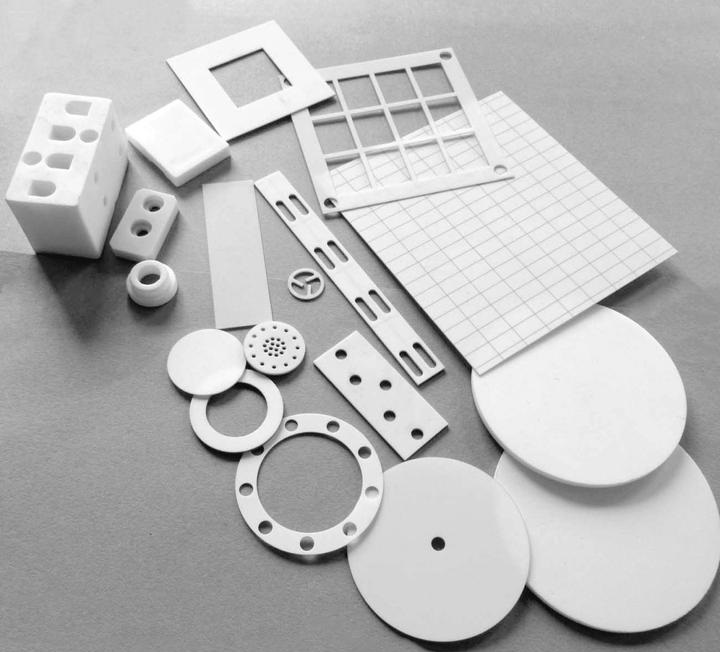


BeO has a hexagonal wurtzite structure. The distance between Be atoms and O atoms is small, the average atomic mass is low, and the atomic packing is dense, which meets the conditions of the model of high thermal conductivity ceramics for single crystals proposed by Slack et al. In 1971, Slack and Auterrman measured the thermal conductivity of BeO ceramics and BeO large single crystals and calculated that the thermal conductivity of BeO large single crystals could reach up to 370 W/m·K. Currently, the thermal conductivity of BeO ceramics that have been prepared can reach 280 W/m·K, which is ten times that of Al2O3 ceramics.
BeO is widely used in aerospace, nuclear power, metallurgical engineering, electronics industry, rocket manufacturing, etc. In aviation electronic technology conversion circuits and aircraft and satellite communication systems, BeO is extensively used as bracket components and assemblies; it also has application prospects in spacecraft electronics. Due to the particularly high thermal shock resistance of BeO ceramics, they can be used in the ignition tubes of jet aircraft. BeO plates with metal coatings have been used in the control systems of aircraft drive devices; BeO ceramics have good thermal conductivity and are easy to miniaturize, thus having broad application prospects in the laser field, such as BeO lasers having higher efficiency and greater output power than quartz lasers.
Add: No.708, Hangxing Road, Gongshu District, Hangzhou, China. P.C.310011 Tel: +86.13968086893 Fax: +86.571.88095310