


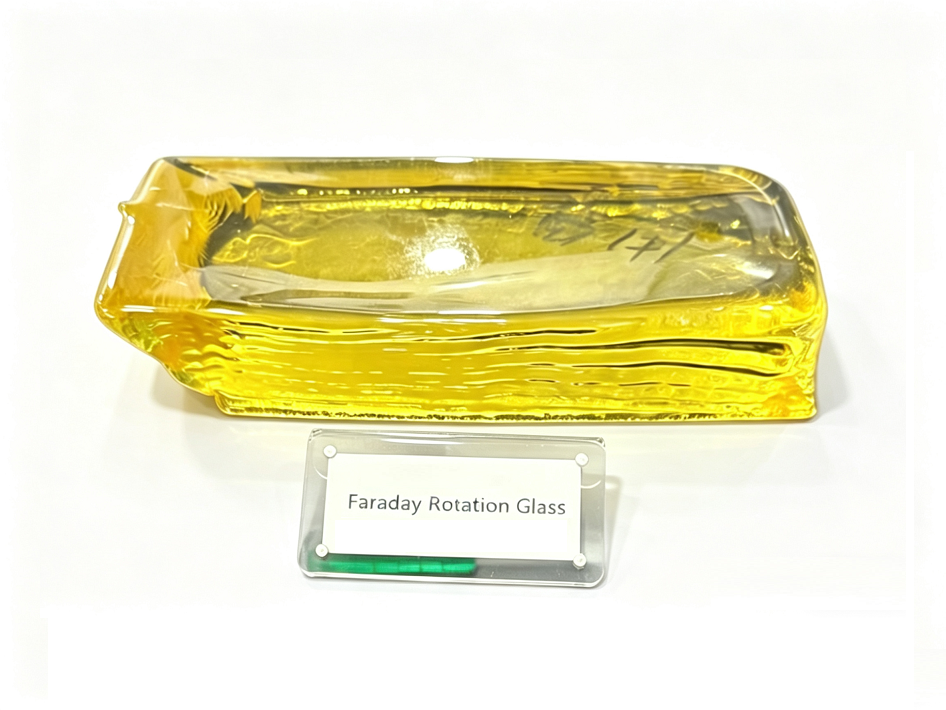

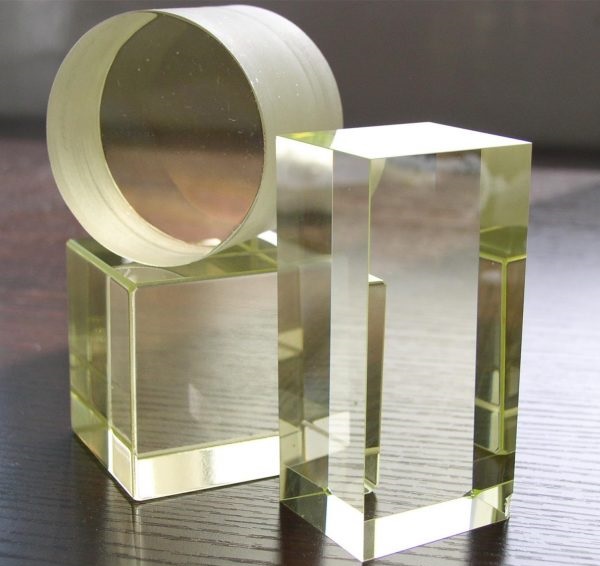

Introduction:
Faraday rotator glass is a novel and important transparent optical functional material in the field of optoelectronic high technology, exhibiting excellent transmittance in the visible and infrared bands (520–1400 nm). It can rotate the polarization plane of a beam of light polarized parallel to the direction of a magnetic field, making it a glass functional material with a strong Faraday magneto-optical effect. Due to its "non-reciprocity," meaning that the polarization planes of both forward and reverse incident light of the same wavelength can be rotated in the same direction by the same angle, regardless of the direction of beam propagation, this material is widely used in the fabrication of Faraday rotators. Faraday rotator glass is more suitable for medium- and low-power lasers and is less expensive than other magneto-optical crystals such as TGG and TSAG. TG20 is widely used in switches, modulators, sensors, magneto-optical isolators, and other fields.
Advantages:
High verdet constant
Low magneto-optical loss
Excellent transparency
Wide magneto-optical effect bandwidth
Good chemical durability
High Kerr magneto-optical rotation angle
High Faraday magneto-optical rotation angle
Applications:
The Faraday Rotator Glass mainly used in faraday rotating components, fabricating optics-isolators, faraday rotators, circulators, magneto-optical modulators, optical switches, interleavers, laser gyroscopes, goniometric devices magneto-optic storage and optical information process system, current measuring transducers for magnetic field measuring and high-voltage transmission line, new generation current sensors, wave guides, iatrology, spaceflight control, satellite survey and other functional devices.
Add: No.708, Hangxing Road, Gongshu District, Hangzhou, China. P.C.310011 Tel: +86.13968086893 Fax: +86.571.88095310